Curious to see how Pinch works? Check it out



Late payment is one of the most damaging and least discussed problems facing Australian small businesses. When invoices go unpaid past their due date, businesses lose cash flow, struggle to cover basic expenses, and in some cases are forced to close. Beyond individual businesses, the cumulative effect of late payment across Australia represents a serious drag on the national economy.
This article covers what late payment really costs, how Australia compares globally, which industries are hit hardest, and what businesses can do to protect themselves today.
What Is Late Payment?
Late payment occurs when a customer or client fails to pay an invoice by its agreed due date. In Australia, this is not an occasional inconvenience. It is a systemic problem affecting businesses across industries, with invoices routinely paid weeks or even months after they fall due.
How Late Payment Damages Your Business
It Triggers a Cash Flow Crisis
Cash flow is the oxygen of any small business. When invoices go unpaid, that oxygen runs out fast.
Businesses waiting on overdue payments struggle to cover day-to-day expenses including rent, wages, and utilities. This creates a cascading effect: missed payments to suppliers, late fees, and in some cases, damage to the business's own credit rating.
The longer a payment is delayed, the higher the risk it will never be paid at all.
It Makes Planning Impossible
Late payment does not just affect what you can spend today. It undermines your ability to invest in tomorrow.
When revenue is unpredictable, decisions about hiring, upgrading systems, or committing to new contracts become significantly riskier. Businesses that cannot forecast their cash position with confidence tend to hold back on the investments that would otherwise drive growth.
Businesses that automate their invoice payment collection consistently report stronger revenue growth as a result. The link between getting paid on time and business growth is well established.
It Affects Mental Health
The financial pressure of unpaid invoices carries a personal cost that rarely gets discussed openly.
For many small business owners, particularly those in the early stages of building a business, not getting paid on time creates doubt. It raises questions about the value of their work and their confidence in the business itself. On-time payment is not just a financial signal. It is a signal of respect that supports the mental wellbeing of the people behind the invoice.
Research published by Barclays Bank found that 39% of small to medium sized business owners say their mental wellbeing has suffered as a result of late payments, with a further 25% reporting reduced work-life balance due to inability to take leave.
It Strains Client Relationships
Chasing overdue invoices is uncomfortable for everyone involved. It creates friction in what should be straightforward business relationships.
The time spent following up on unpaid invoices is time taken away from delivering work and growing the business. When a business is constantly in collection mode, the trust and goodwill it has worked hard to build begins to erode on both sides.
The Scale of Late Payment in Australia
Australia has a serious late payment problem, and the data shows it is getting worse.
A 2017 Plum Consulting report, cited by the Small Business Development Corporation, estimated the total value of late payments to Australian SMEs at nearly $50 billion per year.
A Xero report prepared by AlphaBeta Advisors, Paying the Price: The Economic Impact of Big Businesses Paying Australian Small Businesses Late, analysed more than 10 million invoices from over 150,000 Australian SMBs. It found that 53% of trade credit invoices sent by small businesses are paid late, with payments arriving an average of 23 days after they are due. Extrapolated across the full economy, the report estimated the national value of large business late payment at $115 billion per year.
There are no studies suggesting the situation is improving.
Australia vs the UK and US
Australian businesses wait far longer to get paid than their counterparts in comparable economies.
The AlphaBeta report found Australian invoices are paid an average of 23 days after their due date. The 2017 Australian Small Business and Family Enterprise Ombudsman review, cited by the Small Business Development Corporation, found Australian organisations paid their suppliers an average of 26 days after the due date, compared to no more than one week in the UK and US.
This gap is particularly damaging because many large Australian businesses already impose payment terms of 30, 60, or even 90 days on their small business suppliers. Adding a further 23 to 26 days of delay on top of that means small businesses are effectively financing their larger clients for months at a time.
The Broader Economic Cost
Late payment is not just a problem for individual businesses. It has measurable consequences for the broader Australian economy.
The AlphaBeta report found that if large businesses paid their SMB invoices on time, it would transfer $7 billion in working capital from large businesses to small businesses each year, and deliver a net benefit of $4.38 billion to SMBs over ten years by reducing financing costs and freeing capital for investment in hiring and growth.
Small businesses generate a third of Australia's private-sector GDP and employ nearly half of all workers. When small businesses are financially constrained, the effect ripples through every sector they supply or support, including the cost of goods across the entire supply chain.
In much of the world, governments have intervened with regulation. The European Union established a Late Payment Directive in 2011, specifically because it identified late payment as a drag on the entire European economy.
In Australia, there is no equivalent framework at the federal or state level. The result is a payment culture that operates, as one industry observer put it, like a wild west frontier when it comes to this critical economic issue.
Industries Hit Hardest by Late Payment
Late payment does not affect all industries equally.
According to Illion's March 2023 Economic Snapshot, agriculture, health, retail, and education are among the most severely affected sectors. The AlphaBeta and Xero report found that wholesalers face the longest waits of all, with invoices paid an average of 35 days past their due date.
The pressure on wholesalers illustrates the broader supply chain risk clearly. Wholesalers supply retailers and are typically paid only once the retailer moves the goods. When a retailer has a bad period, the wholesaler absorbs the cost. To account for this risk, wholesalers are forced to build higher margins into their pricing, which flows through to the price of goods across the board. Pinch has heard directly from wholesale customers who have had to write off tens of thousands of dollars when small cafes or retailers close.
B2B service businesses are also consistently hard hit. IT companies, marketing consultancies, and professional services firms regularly report high rates of overdue invoices. For a small consulting firm, a single unpaid invoice can be the difference between making payroll and not.
How to Protect Your Business From Late Payment
Automate Payment Collection With Pre-Approvals
The most effective way to eliminate late payment is to stop relying on customers to initiate it.
A pre-approval is an authorisation from a customer that allows a business to automatically charge their card or bank account when an invoice falls due. Once a customer has submitted a pre-approval, payment is processed automatically on the due date. There is no manual follow-up required.
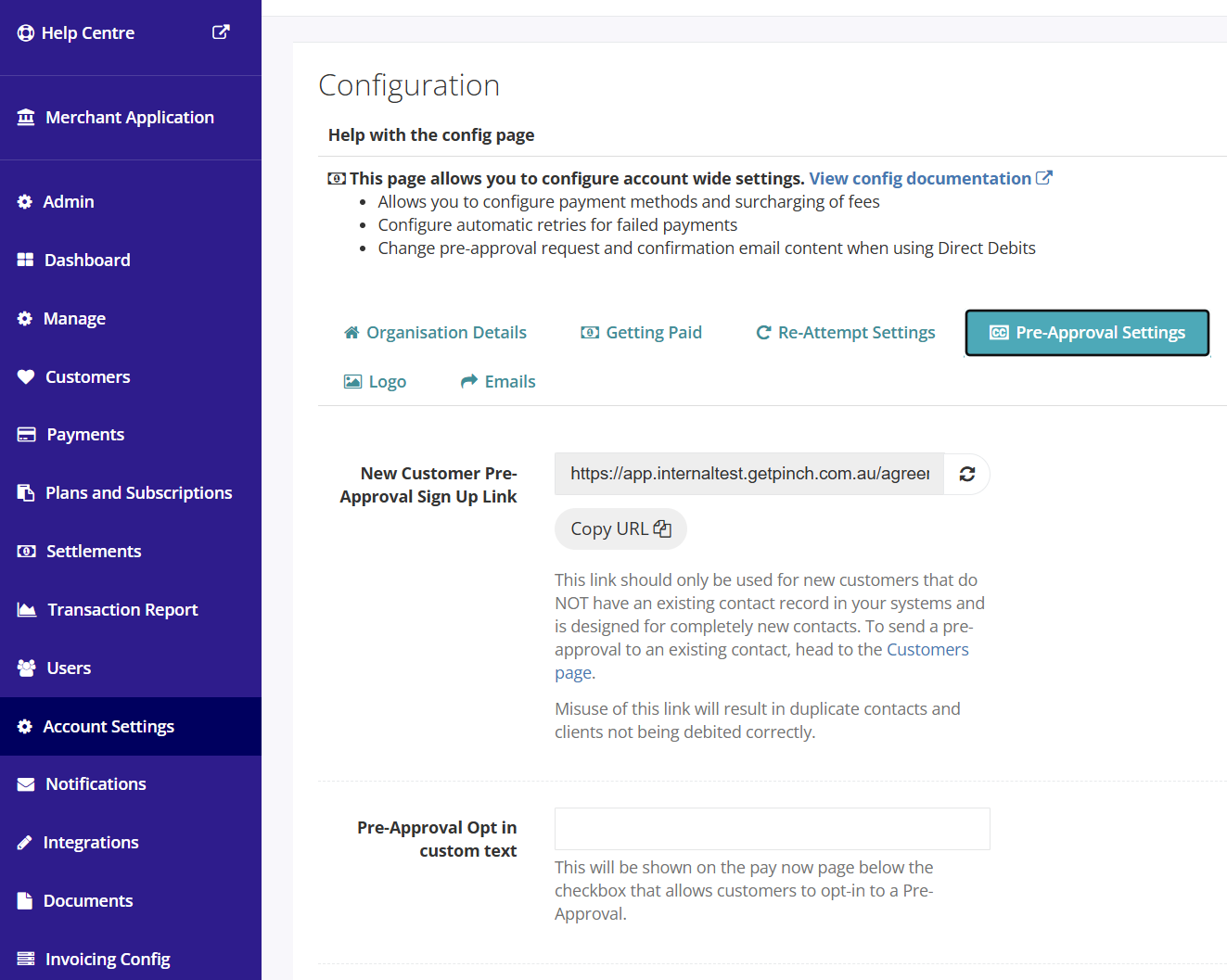
Pinch Payments enables Australian businesses to collect payment via direct debit or card using pre-approvals. To get started:
- Log in to your Pinch account or create one and navigate to the Customers section
- Find the customer you want to add and open their customer details page
- Click "Send Pre-Approval" to email the customer a secure link, or "Launch Pre-Approval Page" to enter their details directly
- Use the Manage Pre-Approvals feature to send pre-approval requests in bulk
Once set up, pre-approvals run automatically. Invoices are charged on their due date, cash flow becomes predictable, and the time spent chasing payments drops to near zero.
Offer Payment Plans
For customers who cannot pay in full, a structured payment plan is often more effective than chasing a single large invoice. It keeps cash moving and preserves the relationship.
Pinch includes pre-built payment plan templates, allowing businesses to break invoices into agreed instalments without manual tracking.
Use Paidnice to Enforce Payment Terms Automatically
In 2024, Pinch Payments and Paidnice jointly launched the Late Payment Alliance, an initiative to shift Australian business culture around payment.
The alliance aims to normalise paying on time, or ahead of time, by encouraging businesses to adopt payment automation, reward prompt payers with discounts, and build a more financially confident business community. The goal is a cultural shift, from the default of "she'll be right" to a new standard of "she'll get paid."
Businesses that join the alliance receive member kits to share content on their website and social media, and receive prominence on the alliance website as it develops.
Conclusion
Late payment is not an inevitable part of doing business in Australia. It is a systemic problem with clear, measurable consequences for businesses and the broader economy.
Australian businesses wait longer to get paid than almost any comparable country. The cost runs into the hundreds of billions of dollars annually. The effects are felt in cash flow, growth decisions, supplier relationships, and the mental health of the people running small businesses every day.
The businesses that protect themselves are not waiting for regulation or cultural change to catch up. They are automating their payment collection, using technology to enforce their terms, and removing the manual friction that allows late payment to persist.
Curious to see how Pinch works? Explore our Interactive Demo Library
Disclaimer: The information provided in this guide is for general informational purposes only. It does not constitute legal, financial, or taxation advice. While we strive to provide accurate and up-to-date details based on current Australian regulations, business requirements can change. We recommend consulting with a qualified accountant, lawyer, or business advisor before making any significant decisions or taking action based on this content.