Curious to see how Pinch works? Check it out




A payments pricing strategy is how a SaaS platform decides to charge customers for payment processing and related features, either through a revenue share with its payment provider or through a custom pricing model it builds and controls. Get this right and payments become one of the most profitable lines in the business. Get it wrong and margins disappear into processing costs.
Most SaaS platforms start out solving one problem well. A booking tool books appointments. An invoicing tool sends invoices. Payments usually arrive later, once customers start asking to get paid inside the same product they already use. That moment is where a pricing strategy decision has to be made, and it shapes revenue for years afterward.
This guide covers the two core approaches to monetising payments, five practical pricing models, the factors that should shape your decision, and how Australian SaaS platforms are using embedded payments to build a second revenue line without becoming a payments company themselves.
What Is Payments Monetisation for SaaS Platforms
Payments monetisation is the practice of generating revenue from the payment transactions that already flow through a software platform, rather than treating payments purely as a cost of doing business. Instead of passing customers off to a separate payment gateway, the platform embeds payment processing directly into its product and earns a margin, a fee, or a share of the value it creates.
For SaaS platforms, this usually shows up in one of three ways: a share of each transaction processed, a fee for access to payment features, or charges for advanced payment tools like faster payouts or automated invoice reconciliation.
Explore how embedded payments work in practice.
Why SaaS Companies Are Monetising Payments
Software platforms are diversifying revenue because subscription pricing alone has a ceiling. A monthly fee only grows as fast as the customer base does. Payments volume grows with customer activity, which means it can scale faster than seat count or subscription tier.
There are three practical reasons Australian SaaS platforms are moving into payments:
1. Payments solve a real customer problem
Businesses already using a platform for scheduling, invoicing, or client management would rather get paid inside that same product than log in to a separate portal or chase a bank transfer.
2. Payments reduce admin for the end customer
Manual invoicing and bank reconciliation take time. A platform that automates collection through direct debit or card payments removes that admin entirely, which becomes a selling point in itself.
3. Payments improve cash flow visibility
When payments and the core product sit in one system, platforms and their customers both get a clearer picture of what has been paid, what is overdue, and what is coming next.
Two Core Approaches to Monetising Payments
There are two broad paths for a SaaS platform to earn revenue from payments. The right one depends on how much control the platform wants over pricing, and how much internal resourcing it has for managing a payments business.
Revenue Share Agreements
A revenue share agreement is where the platform earns a set portion of each transaction processed, without setting or managing the underlying pricing itself. The payments provider handles rate-setting, compliance, and risk, and passes a share of the revenue back to the platform.
This is the simpler starting point. It suits platforms that are embedding payments for the first time and do not have a dedicated payments or pricing team. There is less to manage and less risk of mispricing a new feature, at the cost of less control over margin.
Custom Pricing
Custom pricing is where the platform sets its own rates, fee structures, and packaging for payment features, often working with a payments partner that provides the processing infrastructure underneath. This gives platforms full control over how payments are positioned across pricing tiers.
Custom pricing suits platforms with the internal resourcing to test, adjust, and support their own payment pricing model over time. It takes more setup work but usually produces a higher margin once the model is tuned.
Many platforms end up running both. A revenue share can cover baseline transaction processing, while custom pricing is layered on top for premium features like instant payouts or advanced reporting.
5 Profitable Payments Pricing Strategies for SaaS Companies
Once a platform decides to build its own pricing model, or wants to layer pricing on top of a revenue share, there are five common approaches. Most successful platforms combine more than one.
1. Bundle Payments Into a Higher-Tier Plan
The simplest model is to make payment collection a feature of a higher-priced plan. A basic plan handles the core product. A business or premium plan adds the ability to accept card payments or set up direct debit. This works well when payments are a clear upgrade trigger rather than a core part of every customer's workflow.
2. Add a Transaction Markup
A per-transaction fee, charged as a percentage plus a fixed amount, is the most direct way to earn from payment volume. Platforms can tier this by plan, offering a lower rate on higher-priced subscriptions so heavier users are rewarded for upgrading rather than penalised for processing more.
Platform fees in practice
PassM8 used Pinch to manage flexible platform fees alongside studio payments. This gave PassM8 greater control over its fee structure, although the case study does not disclose net payment margins or profitability.
3. Charge for Advanced Payment Features
Once core payment processing is live, platforms can charge separately for features that improve the experience beyond basic collection. Faster payouts, dishonour and failed payment handling, or automated retry logic for failed direct debits are common examples. These features solve specific pain points, which makes them easier to price and easier for customers to justify paying for.
4. Charge a Fee for Using an External Provider
Some platforms consolidate payment volume with their own provider to keep processing costs predictable, and charge an additional fee if a customer insists on using a different payment method or provider outside the platform. This works best once a platform's own payment offering is mature enough that most customers prefer it anyway.
5. Charge for Reporting and Reconciliation Tools
Payment data is valuable on its own. Platforms that offer advanced reporting, exportable reconciliation reports, or dashboards that match payments to invoices automatically can charge for that layer separately, particularly to bookkeepers and accountants who rely on clean records at EOFY.
What to Consider When Setting Your Payments Pricing Strategy
Charge enough that payments make a measurable difference to the bottom line, but stay realistic about what your market will bear. Two things should shape the number: the value the feature adds for the customer, and the actual processing cost the platform is absorbing underneath it.
1. Benchmark against direct competitors first
If a competing platform bundles payments into its base plan for free, charging separately will be a hard sell unless the feature set is clearly better.
2. Test before rolling out to everyone
Announce a new payment plan to a small customer segment first and watch how they respond, rather than pushing pricing changes to the entire customer base at once. An A/B test on a pricing page, tracking sign-ups against different tiers, gives a cleaner read than guessing.
3. Segment pricing by customer type where it makes sense
New customers who have not started collecting payments online yet often respond well to a limited free trial of payment features, since the barrier to entry is unfamiliarity rather than price.
Larger or strategic accounts may need a bundled discount, particularly if payments are packaged with features like fraud protection or priority support.
Businesses that collect payments in person as well as online usually respond to a combined online and in-person offer, rather than two separate pricing conversations.
How Pinch Helps SaaS Companies Build a Profitable Payments Strategy
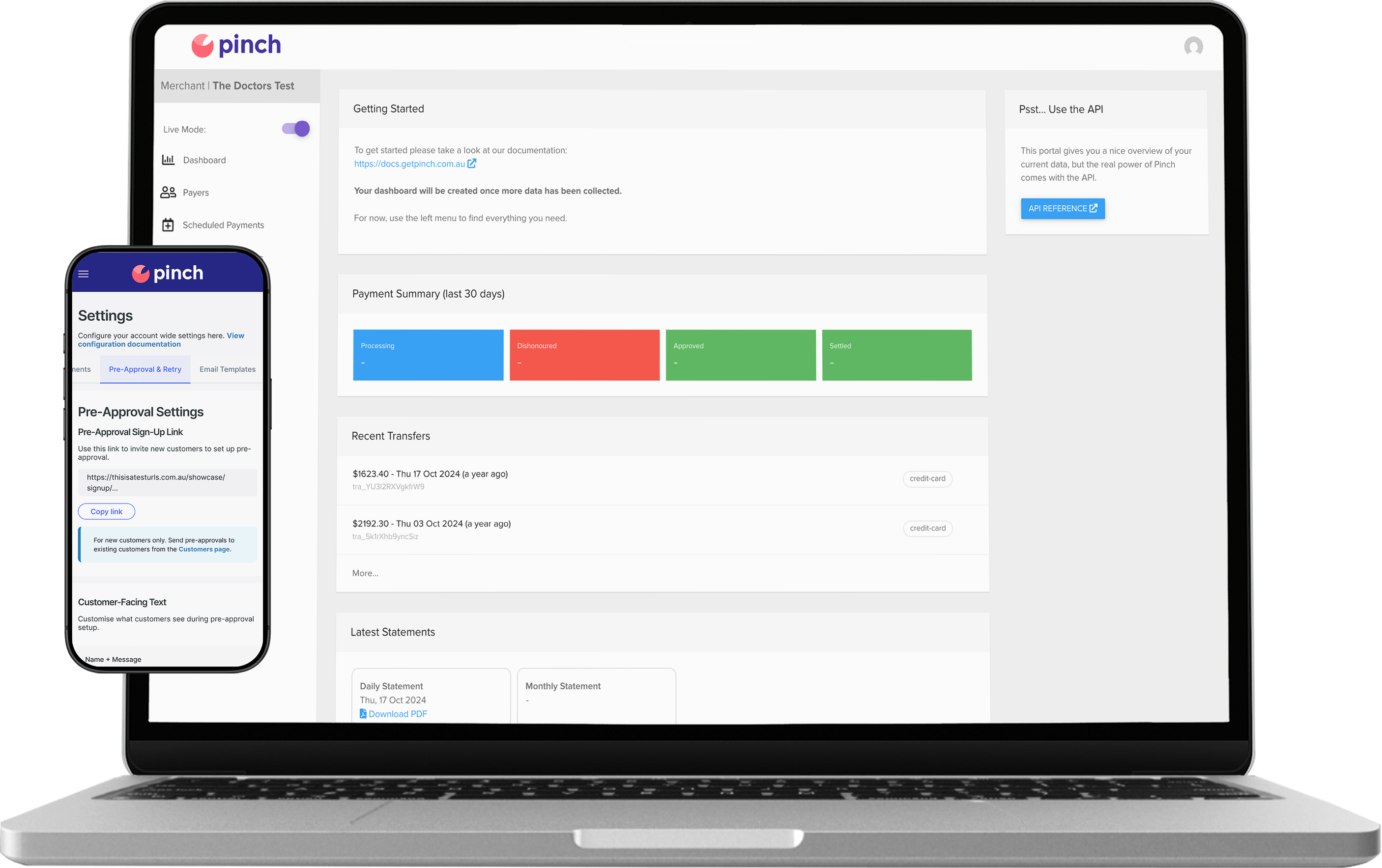
Pinch Glassbox is a PayFac-as-a-Service layer built on top of the Pinch API. It allows Australian SaaS platforms and ISVs to embed payment processing directly into their products, without needing to become registered payment facilitators themselves or manage acquiring relationships and compliance from scratch.
For platforms weighing up the two core approaches above, Glassbox supports both. You can start with a straightforward revenue share model while testing demand for embedded payments, then move towards custom pricing once you have a clearer understanding of your customer segments and transaction volumes.
With Glassbox, you also get access to BECS direct debit, card payments, and a customer payment portal through the same integration, rather than having to stitch together separate tools for recurring billing, one-off card payments, and payment history.
How to Choose a Payment Processing Partner for Your SaaS Platform
Once you have a clearer idea of how you want to monetise payments, the next step is choosing a payment processing partner that can support that pricing model. The provider’s fees, settlement speed, payment methods, and feature set will directly affect the margin you can build into your offering.
A few factors matter more than others when comparing options. Settlement speed affects how quickly your customers receive funds, which can shape whether faster payouts can be offered as a premium feature. Support for both card payments and direct debit is also important for platforms serving customers with a mix of one-off and recurring payment needs.
API flexibility determines how much of the payment experience you can control and brand as your own, rather than redirecting customers to a third-party checkout. You should also consider whether the provider offers a PayFac-as-a-Service model or a standard processing relationship, as this affects how much responsibility your platform takes on for merchant onboarding, compliance, and payments operations.
The support available during implementation matters too, especially when your payment setup needs to fit an existing product.
Different SaaS payment processing tools handle these trade-offs differently. Choosing a partner that matches your pricing strategy from the start can make it much easier to scale payments revenue without having to rework your setup later.
Disclaimer: The information provided in this guide is for general informational purposes only. It does not constitute legal, financial, or taxation advice. While we strive to provide accurate and up-to-date details based on current Australian regulations, business requirements can change. We recommend consulting with a qualified accountant, lawyer, or business advisor before making any significant decisions or taking action based on this content.