Curious to see how Pinch works? Check it out



If your software handles invoices, subscriptions, memberships or recurring services, payments are likely already part of your users’ workflow, even if they happen outside your platform.
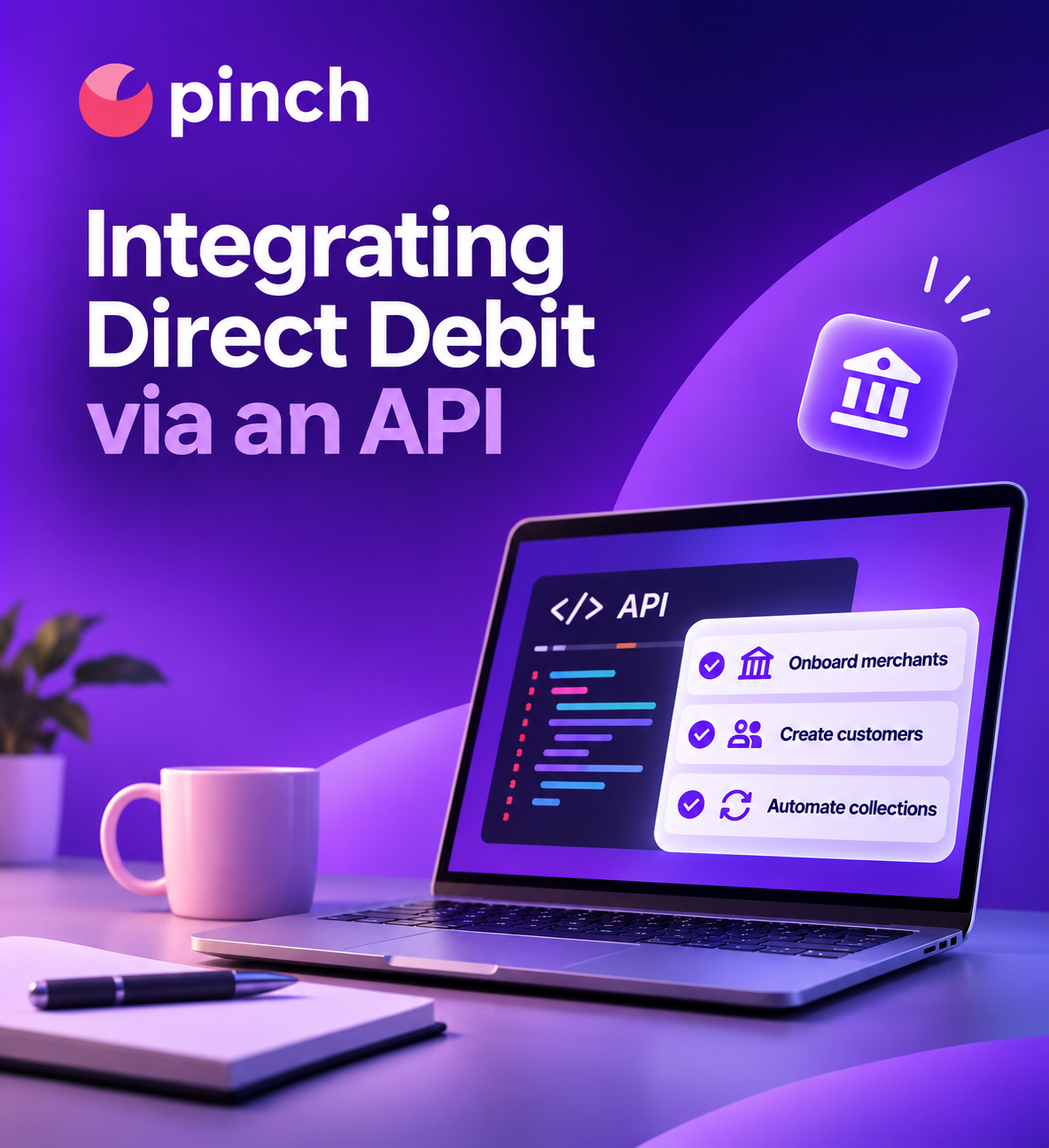
Integrating Direct Debit via an API brings that process into your software. Users can collect authorised payments from customer bank accounts while your platform manages onboarding, payment requests, transaction status and reconciliation.
And you don’t necessarily need to build the payments infrastructure yourself.
Here’s how an API-based Direct Debit integration works, what to consider and what a good implementation looks like.
What is a Direct Debit API?
Direct Debit allows a business to collect money directly from a customer’s bank account after receiving the appropriate authority from that customer.
In Australia, Direct Debit payments are commonly processed through BECS (Bulk Electronic Clearing System).
A Direct Debit API gives your software a programmatic way to interact with the payment infrastructure behind that process.
Depending on the provider and integration model, your software may be able to use API endpoints to:
- onboard merchants;
- create and manage customers;
- establish payment authorities;
- securely associate bank account payment methods with customers;
- initiate payments;
- automate recurring or invoice-driven collections;
- monitor payment statuses;
- respond to failed payments;
- retrieve transaction and settlement information; and
- connect payment information with accounting or reconciliation workflows.
The result is a payment experience that can feel like a native part of your software rather than a separate service bolted onto it.
Why Integrate Direct Debit into Your Software?
For software companies, embedded payments can remove a surprisingly large amount of friction.
Imagine you operate software for a pool servicing business.
Your user completes a job and creates an invoice on your platform. Without integrated payments, the customer might receive the invoice, manually log into online banking, make a bank transfer and enter a reference. Someone then needs to work out which invoice the payment belongs to.
Now imagine the customer has already authorised Direct Debit.
Your software creates the invoice, the payment can be initiated according to the agreed payment arrangement, its status is returned to your application and the transaction can flow into the appropriate reconciliation process.
That’s a much more connected workflow.
For businesses providing recurring services, the benefits can be particularly significant. Pinch’s own strategy focuses heavily on service-based businesses that invoice regularly, including home services, professional services, education and medical or allied health businesses.
How Do You Integrate Direct Debit Using an API?
Every payments API works differently, but there are several common components your development team will need to think about.
1. Connect your application to the payments API
The first step is establishing the connection between your software and your payments provider.
Your development team will typically configure authentication and build against the relevant endpoints for customers, payment methods and transactions.
Good documentation matters here, but so does having access to technical support when your particular workflow doesn't fit neatly into a generic example.
Pinch's developer offering includes a documented payments API alongside implementation consultation and project integration support.
2. Onboard your merchants
If your software is used by multiple businesses, you also need to think about the businesses receiving the money.
Payment providers need to identify and verify merchants before they can process payments. This can involve processes such as KYC (Know Your Customer) and KYB (Know Your Business).
Exactly how merchant onboarding fits into your application will depend on your payment model and provider.
The important thing is to consider onboarding early in the project rather than treating it as something to work out after you've built the transaction flow.
3. Create customers and establish payment authorities
Before a direct debit payment can be collected, the customer needs to provide the appropriate authority.
Your software therefore needs a way to connect the customer in your application with the relevant customer and payment information within the payments platform.
Security is particularly important at this point.
Sensitive payment information shouldn't be stored unnecessarily within your own application. A properly designed integration should minimise your exposure to sensitive financial information and use secure payment infrastructure for handling payment details.
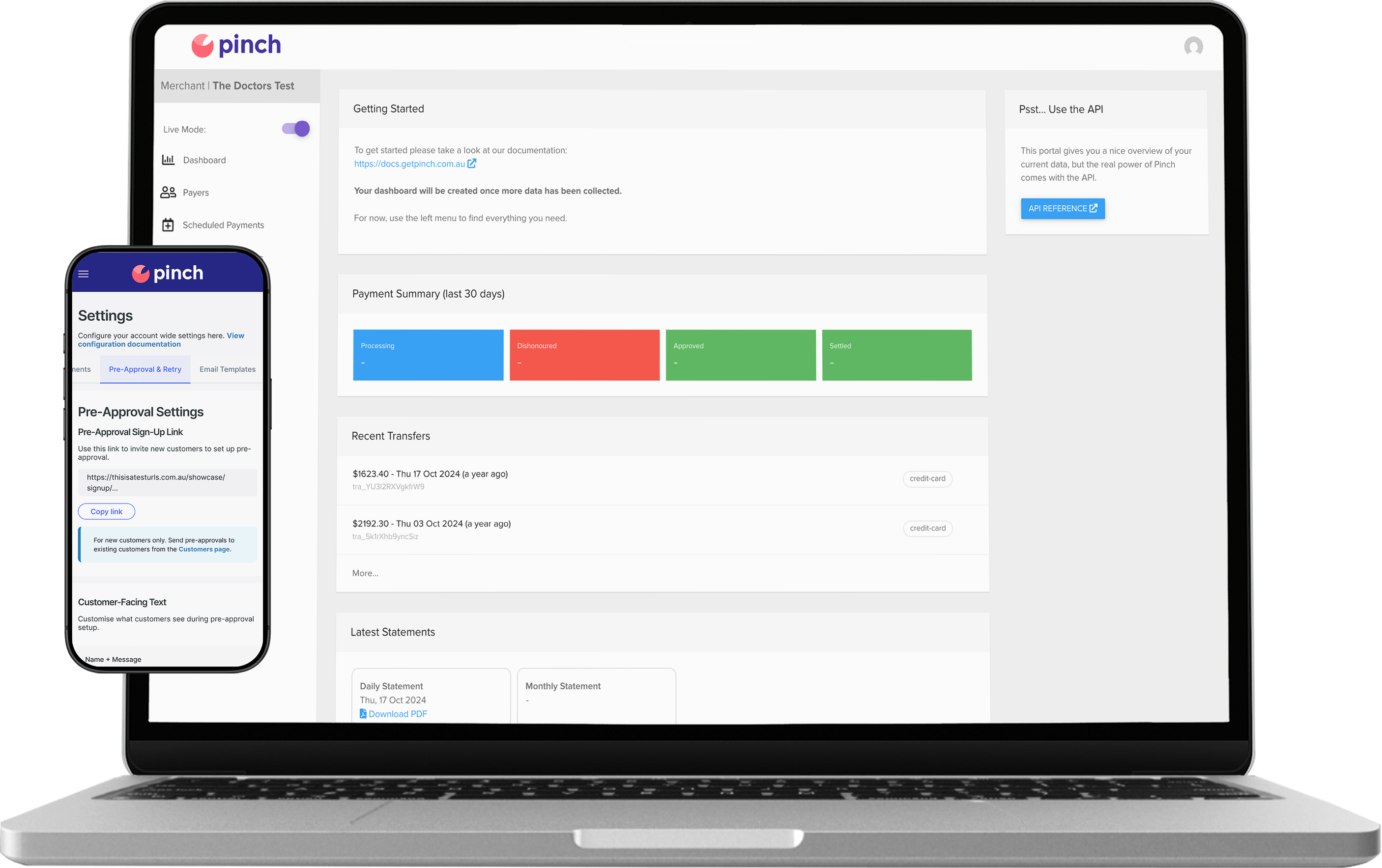
Pinch uses tokenisation to securely store customer payment details.
Not sure how Direct Debit should fit into your product architecture?
4. Initiate the payment
Once the required authority is established, your software can use the API to initiate a payment.
The trigger depends entirely on your product.
For invoicing software, it might be the invoice due date. For membership software, it might be a recurring billing schedule. For job management software, payment might be triggered after work is completed.
This is where embedded payments become particularly useful: the payment can respond to events already happening inside your application.
Instead of asking the user to recreate payment instructions somewhere else, your software can make payments part of the workflow they already use.
5. Monitor the payment status
One important distinction when working with Direct Debit is that successfully submitting an API request doesn't necessarily mean the payment itself has been successfully completed.
Your application needs to account for different transaction statuses and possible failures.
Webhooks are commonly used to notify your application when an event occurs, allowing your software to respond to changes in payment status without constantly requesting updates.
Your integration should also consider what happens when something goes wrong.
For example, what does your user see when a payment fails? Can they identify which customer and invoice are affected? Can your system safely retry an action without accidentally creating a duplicate transaction?
Designing those experiences alongside the successful payment flow will make the finished integration much more useful.
Don't Forget About Reconciliation
It's easy to focus on collecting the money and overlook what happens afterwards.
But your users don't just need to know that they were paid.
They need to know what they were paid for.
Your integration should maintain a reliable relationship between transactions and the relevant records inside your platform, whether that's an invoice, subscription, membership, job or customer account.
This becomes particularly valuable if your software also integrates with accounting systems.
Pinch connects with Xero, MYOB, and QuickBooks, with payments and reconciliation forming part of the wider automated payment workflow.
A well-designed integration can therefore remove several manual steps rather than simply replacing one way of moving money with another.
Want payments and reconciliation to work together? See how Pinch can support your software integration.
Should you integrate Direct Debit only?
Direct Debit might be the reason you're starting the project, but it's worth considering what your users could need next.
Some customers prefer paying from a bank account. Others want to use a credit or debit card. Your users might eventually ask for digital wallets, recurring payments or other payment options.
If you choose infrastructure that supports multiple payment methods, you can give yourself more flexibility without starting another payments integration from scratch every time your product requirements change.
Pinch's developer offering includes multiple payment services, including BECS Direct Debit, cards and wallets.
That allows software companies to think about the integration as a broader payments capability rather than simply adding one Direct Debit button.
What should you look for in a Direct Debit API provider?
API documentation should certainly be on your checklist, but it's only one part of the decision.
Look at how the provider handles merchant onboarding, payment authorities, security, transaction statuses, reconciliation and multiple payment methods.
Then look at what happens when your developers need help.
Payments integrations rarely exist in isolation. Your platform may have its own customer structure, billing logic, accounting integrations and user experience requirements. Being able to work through those requirements with people who understand the payments infrastructure can make a substantial difference during implementation.
That human element is an important part of how Pinch approaches integrations. One Pinch customer specifically highlighted both sides of the experience: “The api documentation is good and the team are amazing to work with and quick to respond.”
Good documentation helps your developers get started.
Good technical support helps them get the integration into production.
Integrate Direct Debit with Pinch API
Pinch provides Australian-made payments infrastructure for software companies that want to integrate payments into their own products.
Our Payments API is designed to support embedded payments, multiple merchants and integrations with accounting systems, with payment options including BECS direct debit, cards and wallets.
And because payments can get complicated, there's a team behind the technology.
Pinch provides implementation consultation and technical support to help your developers work through the integration and build a payment experience that fits your software.
Because a good payment API should give your developers the technology they need.
A good payment partner should also give them people they can talk to.
Ready to add Direct Debit to your software? Get started with Pinch and explore how our Payments API can help you build Direct Debit into your software.
Disclaimer: The information provided in this guide is for general informational purposes only. It does not constitute legal, financial, or taxation advice. While we strive to provide accurate and up-to-date details based on current Australian regulations, business requirements can change. We recommend consulting with a qualified accountant, lawyer, or business advisor before making any significant decisions or taking action based on this content.