Curious to see how Pinch works? Check it out


.jpg)
If you run a SaaS business in Australia and collect payments from customers, credit card surcharges have probably crossed your mind. Do you absorb the processing cost yourself? Do you pass it on? And what are you actually allowed to do under Australian law?
The rules are more nuanced than most business owners realise, and they are also changing. With a confirmed ban on card surcharges taking effect from 1 October 2026, now is the time to understand where things stand, what it means for your margins, and how the right payment infrastructure can keep you ahead of the change.
What Is a Credit Card Surcharge?
A credit card surcharge is an additional fee a business charges a customer when they pay by card. Under Australian law, if a fee applies specifically because a customer chooses to pay by card, it is treated as a surcharge and must comply with surcharge regulations. This applies regardless of whether the fee is labelled a "processing fee," "admin fee," or "payment fee."
Regulators have made it clear that the label does not matter. Any charge tied to a specific payment method is a surcharge and must follow the relevant rules.
Can You Pass On Credit Card Surcharges to Customers in Australia?
Yes, but only up to 1 October 2026, and only up to your actual, verifiable cost of acceptance. This applies today under current RBA rules. From 1 October 2026, the RBA's ban on card surcharging takes effect across the Mastercard, Visa and eftpos networks, and businesses will no longer be able to add a surcharge at checkout for card payments on those networks.
Under the current rules, general overheads like wages, rent, or administrative expenses cannot be rolled into a surcharge. The allowable costs are:
- Card network and acquiring fees charged by card schemes
- Payment processor and gateway fees tied specifically to card processing
- Terminal rental and maintenance fees proportionally allocated to card transactions
- Fraud and chargeback-related fees specifically associated with card payments
- Any other documented, card-specific expenses supported by contracts or statements
Processing fees vary depending on the payment method, provider, and merchant circumstances. Rather than comparing transaction fees alone, businesses should also consider factors such as reconciliation, automation, and customer payment options when evaluating payment platforms.
The Rule on Excessive Surcharges
A surcharge becomes illegal the moment it exceeds what it actually costs the business to accept that payment method. Businesses must also clearly disclose any surcharge to customers before they pay, and if every available payment method carries a surcharge, the minimum total price including that surcharge must be displayed upfront.
For SaaS businesses, this matters enormously. Subscription billing, invoice automation, and recurring payments each create opportunities to inadvertently overcharge or to absorb costs you have legitimate grounds to recover.
The Big Change Coming: Surcharge Ban from 1 October 2026
This is the headline development every Australian SaaS founder and finance lead needs to know.
The Reserve Bank of Australia has confirmed it will remove card surcharges on payments made on the EFTPOS, Mastercard, and Visa networks from 1 October 2026. This is part of a three-part regulatory reform package that also lowers interchange fees and requires card schemes and acquirers to publish more transparent fee data.
About 16% of businesses currently use surcharges. The RBA estimates this change will lower fees for businesses by around $910 million per year, with small businesses expected to benefit from larger proportional fee reductions than large businesses.
Notably, American Express operates under a separate agreement with the RBA and is not subject to the same rule changes.
What This Means for Pinch Merchants
We support the RBA's direction toward a more transparent and simplified payments landscape. Clear, upfront pricing benefits everyone, and it aligns closely with our mission to make payments easier to understand and manage.
Here is what you need to know:
From 1 October 2026, the ability to apply surcharges within the Pinch platform will be removed automatically across all merchants. No manual action will be required on your end to meet the deadline.
We also want to be transparent about our approach to pricing during the transition. The broader structure of merchant fees across the industry is still evolving, and we will not be making immediate changes until there is greater clarity closer to the October date. Our goal is to ensure any future adjustments are thoughtful, balanced, and in the best interests of our merchants.
Over the coming months, you can expect us to keep you informed as more details emerge and provide practical guidance on managing payment costs in a post-surcharge environment.
What This Means for Your SaaS Business
For most SaaS businesses, the October 2026 change creates two immediate planning needs.
The first is reviewing your current surcharge strategy. If you are currently passing on card fees to customers, you will need to discontinue this practice for EFTPOS, Mastercard, and Visa transactions by 1 October 2026 and factor those processing costs into your pricing instead. It is important to note that American Express operates under a separate agreement and is currently excluded from this specific ban.
The second is evaluating your payment processing costs. The accompanying reduction in interchange fee caps is intended to lower the underlying cost of accepting card payments, particularly for small businesses, which should partially offset the lost ability to surcharge.
How SaaS Businesses Are Getting This Wrong Right Now
Even before the upcoming ban, many SaaS businesses are handling surcharges incorrectly in ways that expose them to ACCC enforcement action or customer complaints. Common mistakes include the following.
Charging a Flat Fee Surcharge Carelessly
Flat fee surcharges can easily exceed the actual cost of acceptance on low-value transactions. A 50-cent flat fee on a $5 transaction represents a 10% surcharge, which is well above any legitimate cost of acceptance.
Averaging Surcharges Incorrectly
You cannot simply average out the costs across different card types and apply a blended rate. If your cost of acceptance is 1% for Visa debit and 1.5% for Visa credit, and you want to apply a single surcharge rate, it must be 1%, which is the lower of the two.
Labelling Surcharges as Something Else
Calling a card payment surcharge an "admin fee" or "processing charge" does not exempt it from surcharge rules. The ACCC has made clear that the label is irrelevant; it is the function of the fee that determines its classification.
Failing to Update Surcharge Amounts
Businesses are expected to review and update surcharge amounts when their payment processing costs change. Leaving outdated fees in place is a compliance risk.
How to Handle Payment Surcharge Compliance as a SaaS Business
Rather than treating surcharges as an afterthought or scrambling to comply with each regulatory update, forward-thinking SaaS businesses are building compliant, flexible fee structures directly into their payment infrastructure. Identifying the top SaaS payment processing tools for Australian businesses is a critical step in ensuring your stack is ready for the transition period leading up to 1 October 2026.
This is where purpose-built Australian payment technology makes a genuine difference.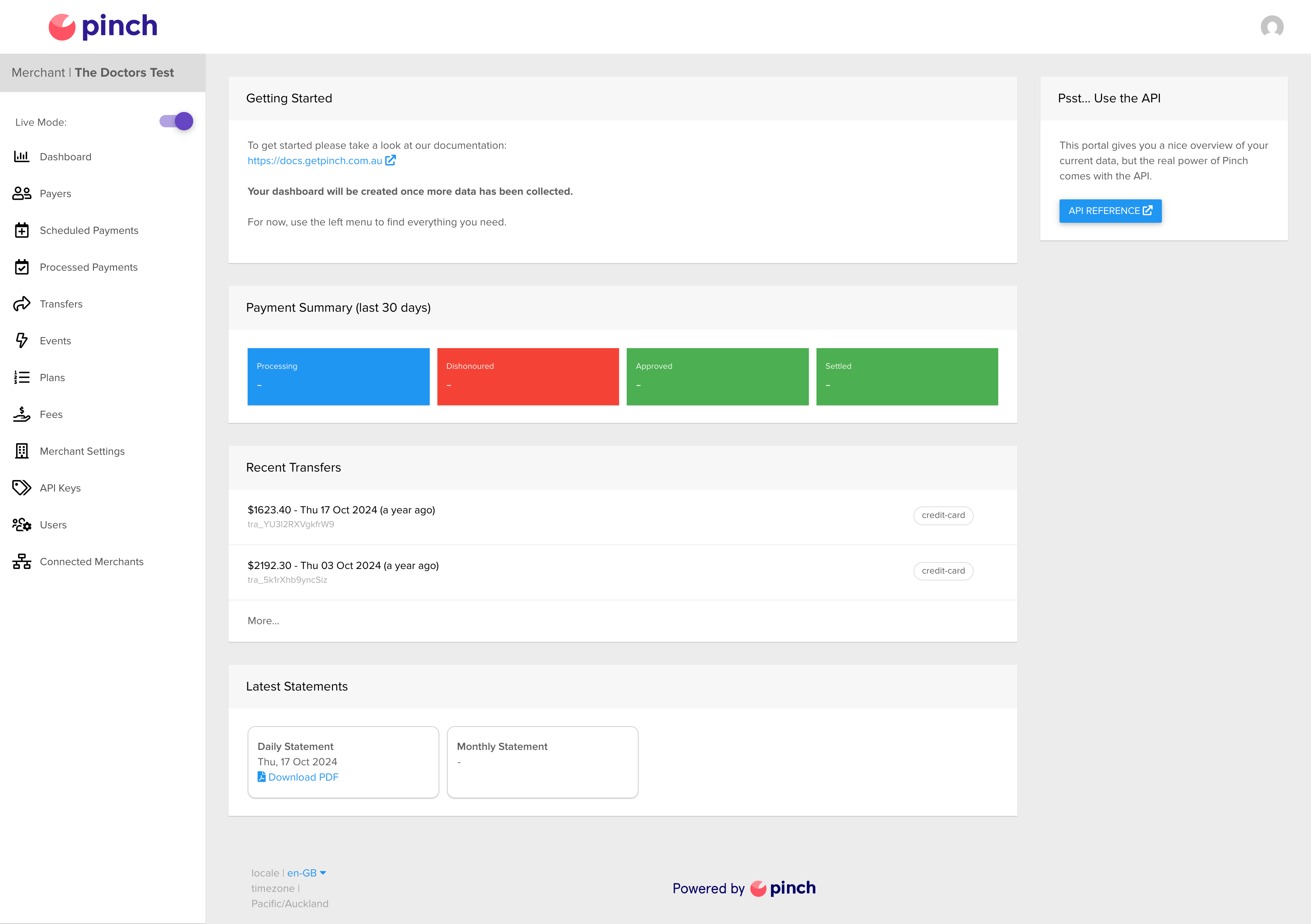
Pinch Glassbox: PayFac-as-a-Service Built for Scale
For SaaS platforms that want complete control over how payment fees are structured and surfaced to merchants and end customers, Pinch Glassbox is Australia's PayFac-as-a-Service platform, and the only one that handles every layer of the compliance and fee management stack inside a single system.
Becoming a payment facilitator used to mean stitching together compliance infrastructure, acquirer relationships, fraud tools, and merchant management from multiple vendors. Glassbox replaces that entire stack. Merchant onboarding and KYC are fully automated through FrankieOne, covering identity verification, AML, PEP and sanctions screening, and real-time ASIC checks. Once merchants are onboarded, everything else runs inside the same platform.
For surcharge compliance specifically, here is what that looks like in practice:
- Custom fee and disbursement engine: Configure custom fee schedules per merchant, with pricing based on card scheme, funding source, and transaction origin. Surcharging can be passed directly to cardholders where legally permitted, promotional pricing can be applied, and temporary fee structures can be activated, all without touching multiple systems. Full margin visibility at the transaction level, including interchange, scheme fees, and merchant service fees, means you always know whether your fee structures remain within legal limits.
- Merchant Management System (MMS): The centralised MMS gives you a complete audit trail across your entire merchant hierarchy, with role-based access controls, full transaction history, and chargeback and dispute tracking. When regulators or acquirers ask questions, everything is in one place, not spread across three different dashboards.
- Scheme and government-compliant statements: Merchant statements generated through Glassbox meet both card scheme requirements and Australian regulatory standards. This is the exact documentation your merchants need to calculate and verify their own cost of acceptance, and the documentation you need if the ACCC comes knocking.
- Real-time transaction visibility: Every transaction is visible in real time at every level of the hierarchy, from acquirer to PayFac to merchant, so compliance is always auditable, not reconstructed after the fact.
- Dedicated support layer: Each Glassbox client has an assigned account manager with direct phone and email access, plus ongoing guidance on fee structure setup, regulatory updates, and acquirer best practices. As the rules around surcharging continue to evolve through 2026 and beyond, having that support built into your payment infrastructure is worth factoring into your platform decision.
For platforms managing payments at scale across multiple merchants, having a compliant fee infrastructure is not optional. Glassbox takes that complexity off your plate without requiring you to build it from scratch.
Pinch Payments API: Flexibility for Developers
For development teams building custom billing or payment workflows, the Pinch Payments API offers a fully API-first architecture. Anything the Pinch platform can do, including recurring billing, invoice automation, pre-approvals, and direct debit, can be accessed and configured programmatically.
This means your engineering team can build surcharge logic, fee configuration, and payment routing directly into your product, without relying on a rigid third-party payment gateway that may not keep pace with Australian regulatory changes.
How to Prepare Your SaaS Business for the 2026 Surcharge Ban
Whether you currently surcharge or not, here is a practical checklist.
1. Review Your Current Pricing and Payment Cost Structure
Pull your payment processing statements and confirm your actual cost of acceptance for each card type. This is the foundation of any compliant surcharge and the baseline you need to rethink pricing if surcharging is removed.
2. Audit Your Existing Surcharge Labels and Disclosures
Confirm that all surcharges are disclosed clearly before payment, accurately reflect your costs, and are not mislabelled as administrative or processing fees.
3. Model the Impact of October 2026 Changes on Your Unit Economics
For SaaS businesses with significant transaction volumes, absorbing card processing costs will directly affect gross margin. Adjust subscription pricing proactively rather than reactively.
4. Evaluate Your Payment Infrastructure
If your current payment setup does not give you granular visibility into processing costs per card type or does not allow flexible fee configuration, that is worth solving before the deadline. A unified system like Glassbox handles fee management, compliance, reporting, and merchant control in one place, rather than across separate tools that may not talk to each other when you need them to.
Simplify Your Payment Processing with Pinch Glassbox
The regulatory landscape around credit card surcharges in Australia is shifting. SaaS businesses that understand the current rules, prepare for October 2026, and invest in flexible payment infrastructure will be in a much better position than those treating payments as a compliance problem to deal with later.
Whether you are looking for enterprise-grade fee management through Glassbox or a custom integration via the Pinch API, Pinch has the infrastructure to support your next stage of growth.
See how Australian businesses are building compliant, automated payment workflows that help them get paid faster, with less manual follow-up.
Disclaimer: The information provided in this guide is for general informational purposes only. It does not constitute legal, financial, or taxation advice. While we strive to provide accurate and up-to-date details based on current Australian regulations, business requirements can change. We recommend consulting with a qualified accountant, lawyer, or business advisor before making any significant decisions or taking action based on this content.