Curious to see how Pinch works? Check it out



The best payment API depends on what your product needs to do: collect recurring Australian payments, support international checkout, or connect online transactions with in-person sales. For developers planning a 2027 integration, Pinch, Stripe, Square, PayPal, Adyen and GoCardless each deserve a place on the shortlist. This guide compares their practical strengths and trade-offs. It draws on currently documented capabilities, so confirm availability, pricing and integration requirements before launch.
What Makes a Payment API Developer-Friendly?
A payment API lets your software request and manage payments through a provider's infrastructure. A useful integration covers more than a successful checkout: it also handles saved payment methods, refunds, failed collections, payment status and settlement records.
Look for clear documentation, a realistic sandbox, secure tokenisation, reliable webhooks and predictable versioning. The right provider should make your billing workflow easier to maintain, as well as easier to build.
APIs Worth Considering for 2027
1. Pinch Payments
Best fit: Australian SaaS platforms and developers embedding card and BECS Direct Debit payments.
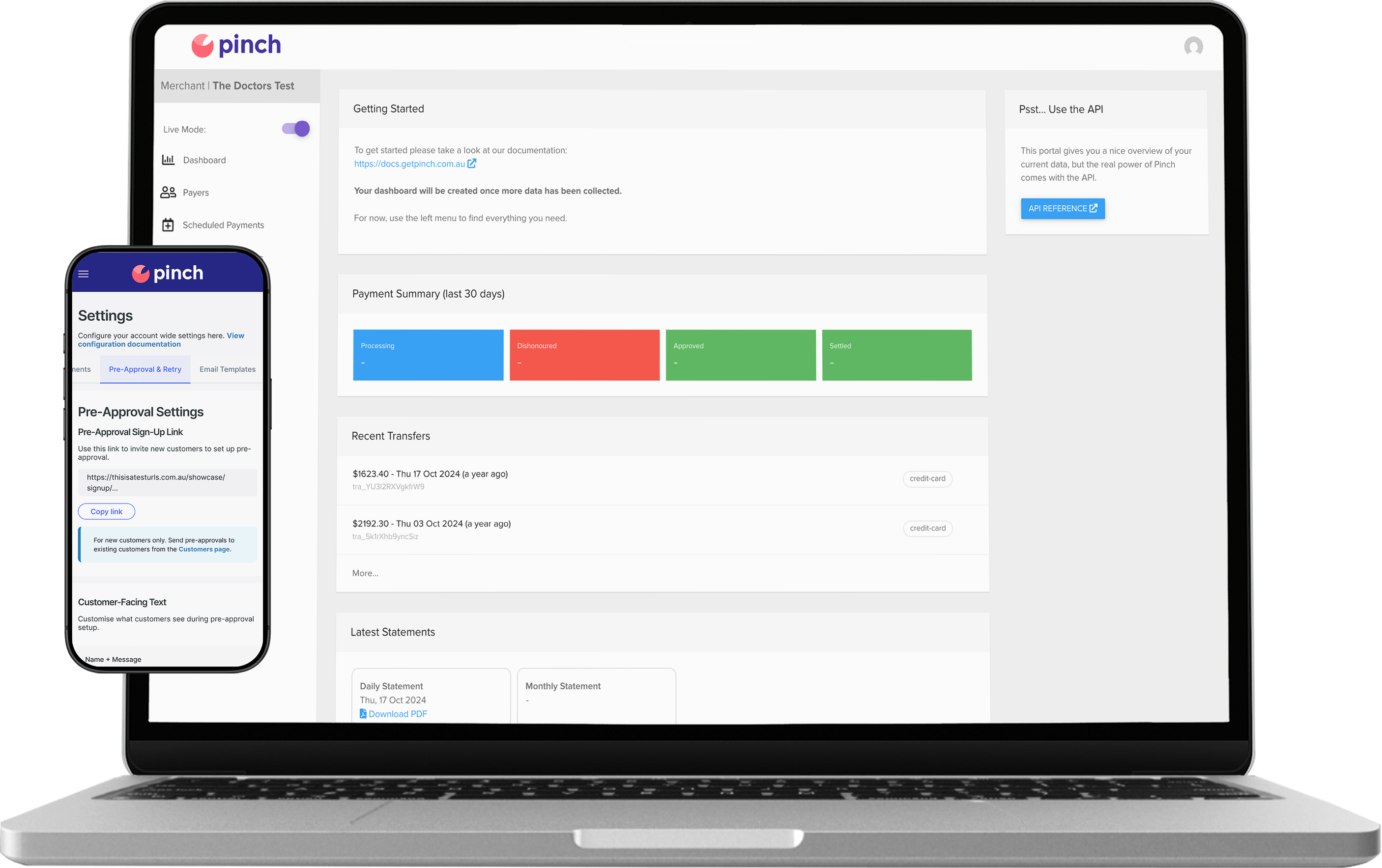
Pinch combines card and Australian bank payments in one REST API using JSON. Developers can manage payers and payment sources, create one-off payments, and use Plans and Subscriptions for recurring schedules. Hosted payment links offer a simpler option when a custom checkout is unnecessary.
Its free sandbox includes time-travel testing, letting you simulate future billing and settlement events instead of waiting through a real collection cycle. Interactive documentation, a Postman collection and an official .NET SDK help teams explore the integration. For platforms collecting payments on behalf of other businesses, Managed Merchants provides a separate integration path. Pinch also offers local integration support, which can matter when you need help with a payment workflow rather than just an endpoint.
WorkGuru used the Pinch API to build GuruPay, an embedded payments product within its job management platform. Tony Harcourt, Co-Founder of WorkGuru, describes the experience: “The Pinch API is truly world-class, and the team was an absolute breeze to work with.”
Read More on WorkGuru Case Study
Consideration: Start with your Australian collection requirements. If global payment-method coverage or multi-currency operations are central to your product, assess internationally focused providers alongside Pinch.
2. Stripe
Best fit: Teams building flexible online checkout with room for more complex payment flows.
Stripe offers hosted or embedded Checkout and APIs for payment methods and payment lifecycles. Checkout can reduce the amount of checkout logic your team builds, while Payment Intents gives developers more control over complex flows and authentication.
Consideration: Choose the integration path deliberately. A custom flow creates more engineering work than a hosted checkout, and additional billing or platform products should be assessed separately. Confirm which payment methods and settlement currencies your business can actually use.
3. Square
Best fit: Applications serving businesses that already use Square for commerce or point-of-sale.
Square's Payments API creates and captures payments using sources supplied by its client SDKs. Payments can connect to orders, while webhooks notify your application about payment activity across supported Square products. That makes it worth exploring when your software needs to work with an existing Square operation.
Consideration: Payment methods vary by country. For example, Square's documented ACH bank payment support is US-specific; it should not be treated as Australian BECS Direct Debit support.
4. PayPal
Best fit: Checkout experiences where customers want to pay through PayPal.
PayPal's Orders API and JavaScript SDK support a checkout flow that connects the customer's payment approval with server-side order management. Developers can capture payments immediately or authorise first and capture later, depending on the fulfilment workflow.
Consideration: Evaluate recurring payments and other specialised flows separately from a basic checkout integration. Confirm product eligibility and regional availability before assuming one integration covers every billing requirement.
5. Adyen
Best fit: Businesses with complex checkout requirements and an engineering team to support them.
Adyen's Checkout API works with Drop-in or Components on the client side and webhooks on the server side. Its documentation covers payment methods, authentication and tokenisation, giving developers options for shaping the checkout experience.
Consideration: Scope the full integration, including merchant onboarding, reporting and operational support. A broad payments platform can be valuable, but your team still needs to understand which capabilities your business requires.
6. GoCardless
Best fit: Products where recurring bank collection is the main requirement.
GoCardless provides API resources for customers, bank accounts, mandates, payments, subscriptions and instalment schedules. Separate sandbox and live environments, plus events and webhooks, support development around the bank-payment lifecycle.
Consideration: If customers also need cards or wallets, assess how those requirements will be covered. Check supported banking schemes and build around the collection timeline rather than assuming a bank payment behaves like an immediate card transaction.
How to Choose the Right Payment API
Use these six checks to compare providers against the payment workflow your product actually needs.
Map your payment workflow. Write down what happens when a customer signs up, saves a payment method, pays, requests a refund or misses a payment. Identify whether you need one-off charges, subscriptions or variable invoices. This keeps the evaluation tied to your product rather than a provider's feature list.
Check payment methods and market coverage. Confirm that the API supports the methods your customers use and that your business is eligible in each market. For Australian recurring collections, check BECS Direct Debit specifically. Also confirm supported currencies, settlement arrangements and any separate approval required for particular features.
Test the full lifecycle in the sandbox. Build a small proof of concept before committing. Test successful payments, declines, refunds and delayed outcomes. Check webhook verification and duplicate-request protection, including what happens when your application retries a request. Your integration should handle uncertainty without charging customers twice or losing payment updates.
Plan reconciliation from the start. Work out how payment IDs, invoice references, fees, refunds and settlements will reach your accounting records. Ask whether the provider supplies enough detail to explain each bank deposit. A successful checkout is only part of the job; your finance team also needs to match and investigate transactions.
Compare the total cost and support. Model costs using your expected transaction sizes and volumes, including recurring billing, refunds and international payments where relevant. Add implementation and maintenance time. Ask who can help during integration, how issues are escalated and how API changes are communicated. A lower processing rate may not mean a lower overall cost.
Clarify responsibilities for multi-merchant platforms. If your software enables other businesses to collect payments, establish who handles merchant onboarding, verification, disputes and settlement support. Confirm which responsibilities belong to your platform and which belong to the provider. Resolve these boundaries before designing the merchant experience or promising capabilities to customers.
Build Your Australian Payments Workflow with Pinch
For Australian software teams needing cards, BECS Direct Debit and recurring collections, Pinch is a practical starting point. You can test the payment lifecycle, explore managed merchant workflows and speak with a local team about your integration. If your platform needs broader payment facilitation infrastructure, discuss Pinch Glassbox separately from the core API. Match the setup to how your business collects payments today and where your product is heading.
Disclaimer: The information provided in this guide is for general informational purposes only. It does not constitute legal, financial, or taxation advice. While we strive to provide accurate and up-to-date details based on current Australian regulations, business requirements can change. We recommend consulting with a qualified accountant, lawyer, or business advisor before making any significant decisions or taking action based on this content.