Curious to see how Pinch works? Check it out


.png)
A payment facilitator (PayFac) and a payment processor both play important roles in helping businesses accept payments, but they operate at different levels of the payments ecosystem.
A payment processor provides the technology and services that help move payment transactions between merchants, financial institutions and payment networks.
A payment facilitator (PayFac) enables other businesses, known as sub-merchants, to accept payments through an acquiring arrangement managed by the facilitator. This typically involves additional responsibilities for merchant onboarding, risk management and compliance.
For Australian SaaS platforms and Independent Software Vendors (ISVs) exploring embedded payments, understanding the difference is important. The model you choose can influence merchant onboarding, payment revenue opportunities, customer experience and operational responsibilities.
In this guide, we'll explain how payment processors and PayFacs work, compare their key differences and explore how Pinch Payments helps software platforms integrate payment capabilities into their products.
What Is a Payment Processor?
A payment processor is a company that provides technology and services to help businesses process electronic payments.
When a customer makes a card payment, the processor helps communicate transaction information between the relevant payment systems, including the acquiring institution, card network and card issuer.
The issuing bank determines whether to approve or decline the transaction, and the result is communicated back through the payment infrastructure.
A payment processor may provide:
- Transaction authorisation and processing
- Secure payment data handling
- Connectivity to acquiring institutions and payment networks
- Transaction reporting and reconciliation tools
- Refund processing capabilities
- Support for disputes and chargebacks
Depending on the provider, processing services may also be combined with payment gateways, acquiring services and merchant account management.
Some providers work with merchants that have their own acquiring arrangements, while others offer more integrated payment acceptance services.
For Australian businesses collecting payments directly from customers, Pinch Payments provides card and BECS Direct Debit payment capabilities, automated payment collection and integrations with Xero, MYOB and QuickBooks.
What Is a PayFac (Payment Facilitator)?
A payment facilitator, commonly called a PayFac, is a business that enables other businesses to accept payments through a payment arrangement established with an acquiring institution.
In a traditional PayFac model, the facilitator operates under a master merchant arrangement and onboards businesses as sub-merchants.
Rather than each sub-merchant independently establishing a conventional acquiring relationship, the PayFac manages important parts of the merchant onboarding and payment acceptance process.
A PayFac typically handles or coordinates:
- Sub-merchant onboarding and verification
- Merchant underwriting and risk assessments
- Ongoing transaction and fraud monitoring
- Compliance with applicable payment industry requirements
- Dispute and chargeback management
- Merchant reporting and settlement arrangements
The exact responsibilities depend on the acquiring agreement, payment scheme rules and operating model.
For software platforms, this model can support a more integrated payment experience.
For example, a business management platform could allow its customers to accept invoice payments directly within the software, rather than requiring them to organise payment acceptance through a disconnected service.
However, becoming a registered PayFac is not the only way to offer this experience. SaaS platforms can also use payment APIs and managed merchant solutions.
These approaches are part of the broader shift towards embedded payments, where payment functionality becomes part of the software customers already use.
PayFac vs Payment Processor: Key Differences
Although payment facilitators and payment processors work closely together, their responsibilities are different.
1. Merchant Account Arrangements
A payment processor primarily provides transaction-processing services. Depending on the provider, merchants may operate through individual merchant accounts or another supported payment acceptance arrangement.
A traditional PayFac operates under a master merchant arrangement with an acquiring institution and enables approved sub-merchants to accept payments.
The important distinction is that the PayFac takes on additional responsibilities for managing the merchant relationship, rather than simply providing transaction-processing technology.
2. Merchant Onboarding
Under a traditional acquiring model, businesses may need to complete an individual application and undergo verification and underwriting before accepting payments.
A PayFac model can provide a more integrated onboarding process, allowing merchants to register through the facilitator's platform.
Digital verification and automated workflows can help reduce manual administration.
However, PayFac onboarding is not automatically instant. Approval times depend on business verification, risk assessment and acquiring requirements.
3. Risk and Compliance Responsibility
Payment processors, acquiring institutions, PayFacs and merchants all have responsibilities within the payments ecosystem.
A processor generally focuses on transaction processing and the security and operational requirements associated with its services.
A PayFac typically takes on additional responsibilities relating to sub-merchant onboarding, underwriting, transaction monitoring and risk management.
These may include:
- Know Your Customer (KYC) and Know Your Business (KYB) verification
- Fraud detection and monitoring
- Chargeback and dispute management
- Sanctions screening
- Applicable Anti-Money Laundering and Counter-Terrorism Financing (AML/CTF) controls
- Payment scheme compliance
The exact allocation of responsibilities depends on the services provided and applicable agreements and regulations.
For software platforms, these requirements are an important consideration when deciding whether to operate as a PayFac or work with a managed infrastructure provider.
4. Revenue Opportunities
Payment processing can create additional revenue opportunities for SaaS platforms.
Under some PayFac arrangements, platforms may be able to establish merchant pricing and earn revenue based on payment volume.
However, transaction-based revenue is not exclusive to registered PayFacs.
Some embedded payments providers also offer revenue-sharing or configurable fee arrangements that allow software platforms to monetise payments without becoming a PayFac themselves.
For SaaS businesses, the commercial opportunity depends on transaction volume, agreed pricing, processing costs and the partnership model.
5. Control Over the Customer Experience
Both payment processors and PayFac solutions can support integrated payment experiences.
Modern payment APIs can allow software platforms to embed checkout, recurring billing and payment management directly into their products.
A PayFac model may provide additional control over merchant onboarding, pricing, reporting and payment operations.
However, the level of customisation depends on the technology provider and commercial arrangement.
For platforms looking to create a branded payment experience, Pinch's embedded payment solutions for ISVs provide flexible integration options and merchant management capabilities.
PayFac vs Payment Processor: Comparison Table
| Feature | Payment Processor | Payment Facilitator (PayFac) |
|---|---|---|
| Primary role | Processes payment transactions | Enables and manages payment acceptance for sub-merchants |
| Merchant accounts | Depends on the acquiring and provider model | Typically operates under a master merchant arrangement |
| Onboarding | May involve individual merchant applications | Can provide integrated sub-merchant onboarding |
| Compliance | Processing and security responsibilities | Additional merchant underwriting, risk and compliance responsibilities |
| Revenue opportunities | May be available through partner agreements | May include merchant pricing and transaction-based revenue |
| User experience | Can support embedded payments through APIs | Can integrate merchant onboarding and payment operations |
| Operational complexity | Depends on the provider and services | Generally greater for the entity operating as the PayFac |
Neither model is automatically better. The right approach depends on the business's payment requirements, customer relationships and operational capabilities.
Common Misconceptions About PayFacs and Payment Processors
1. A PayFac is just a payment processor with different branding
Not quite.
A payment processor provides the infrastructure and services needed to process transactions.
A PayFac takes on additional responsibilities associated with enabling and managing payment acceptance for sub-merchants.
Although one company may provide both types of services, the functions are distinct.
2. Sub-merchants under a PayFac don't need compliance checks
This is incorrect.
Sub-merchants still need to meet relevant verification and compliance requirements.
The PayFac may manage or coordinate these processes as part of its onboarding infrastructure, but using a PayFac does not eliminate the underlying requirements.
3. PayFac models are only suitable for large marketplaces
PayFac arrangements are not limited to large marketplaces.
Vertical SaaS platforms, industry-specific software providers and other businesses supporting multiple merchants may also benefit from payment facilitation capabilities.
However, becoming a registered PayFac involves significant responsibilities, so a managed embedded payments solution may be more appropriate for some businesses.
4. Payment processors are always cheaper
Not necessarily.
Payment processing costs depend on several factors, including transaction volume, payment methods, merchant risk, fee structures and additional services.
Some providers offer flat-rate pricing, while others use interchange-plus or negotiated pricing models.
A PayFac arrangement may create additional revenue opportunities, but it can also involve greater operational and compliance costs.
The best approach is to evaluate the total cost and commercial benefits of each model rather than comparing transaction rates alone.
5. You must become a PayFac to embed payments into software
This is another common misconception.
Software platforms can integrate payments through APIs or managed merchant arrangements without independently becoming registered PayFacs.
The most suitable approach depends on how much control the platform needs over merchant onboarding, payment processing, pricing and risk management.
Which Model Is Right for Australian Businesses?
The right approach depends on whether your business is collecting payments for itself or enabling other businesses to accept payments.
For businesses collecting their own payments
If your business primarily needs to collect payments from its customers, a payment service provider offering card payments, Direct Debit and automated billing may be sufficient.
For example, professional services businesses, trades, accountants and bookkeepers may benefit from payment automation and accounting integrations without needing to operate as payment facilitators.
For SaaS platforms and ISVs
If your software serves other businesses and you want those businesses to accept payments through your product, embedded payment infrastructure may be more suitable.
This can include:
- Integrating payment acceptance directly into software workflows
- Supporting merchant onboarding
- Offering recurring billing and subscription payments
- Managing transaction reporting
- Exploring payment revenue-sharing opportunities
Depending on the level of control required, a platform may choose a payment API, managed merchant solution or PayFac-as-a-Service model.
For software businesses exploring payment monetisation, the Pinch Platform Partner Program provides opportunities to embed payments and develop additional revenue streams.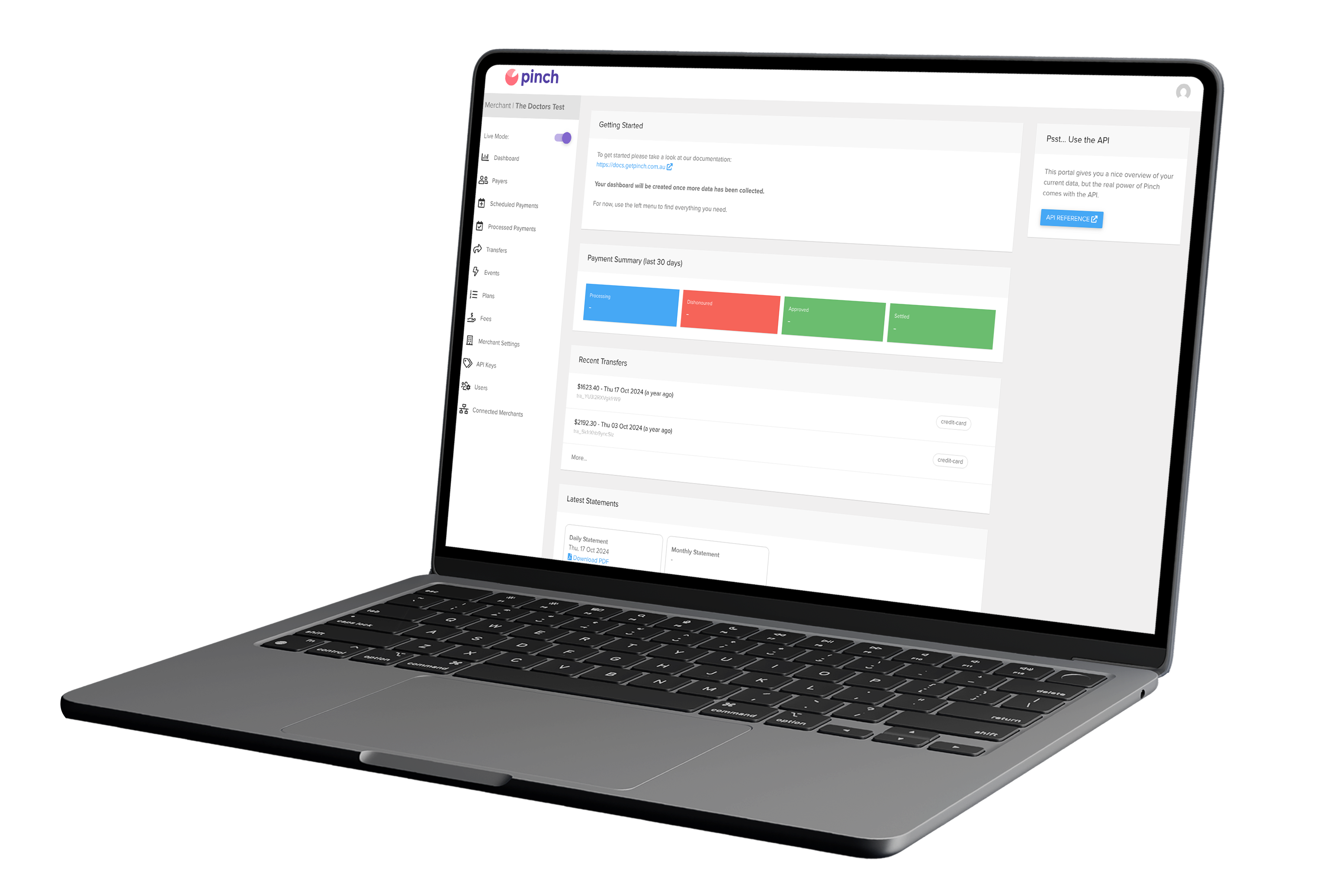
How Pinch Glassbox Fits In
Pinch Glassbox is a PayFac-as-a-Service platform designed to support businesses looking to develop and manage payment facilitation capabilities.
Rather than building all the required technology independently, platforms can use Glassbox infrastructure to support merchant onboarding, compliance processes, payment management and reporting.
Pinch Glassbox provides capabilities including:
Merchant onboarding
Digital onboarding tools that support merchant registration, identity verification and document collection.
Integrated KYC automation
Integration with verification providers, including FrankieOne, to support identity checks, sanctions screening and other relevant compliance processes.
Payment gateway infrastructure
Payment processing technology with transaction information accessible through the Glassbox portal or APIs.
Configurable fees and disbursements
Tools to configure merchant fee arrangements, calculate transaction costs and support payment disbursement processes.
Fraud and risk management
Fraud detection and risk monitoring capabilities, including technology from Kount, an Equifax company.
Merchant reporting
Transaction visibility, merchant statements and reporting across different levels of payment operations.
Glassbox can support businesses exploring a pathway towards operating as a PayFac, while reducing the need to independently develop every component of the payment infrastructure.
Importantly, using Glassbox does not automatically make a software platform a registered PayFac. The regulatory and operational responsibilities depend on the agreed arrangement.
Explore the possibilities
Discover Pinch Glassbox and learn how its PayFac-as-a-Service infrastructure can support your payment strategy.
Start Embedding Payments With Pinch
Not every software platform needs the full operational infrastructure of a PayFac.
For businesses looking to integrate payment acceptance into their existing software, the Pinch Payments API provides access to card payments, BECS Direct Debit, recurring billing and payment management capabilities.
Developers can explore the API documentation, use the sandbox environment and test payment workflows before launching.
Ready to start building?
Create a Pinch account and explore the Payments API to see how payment capabilities can be integrated into your software.
Ready to Find the Right Payment Model?
Choosing between a payment processor, an embedded payments provider and a PayFac model depends on your business goals.
For some businesses, straightforward payment processing is all that's needed.
For SaaS platforms managing multiple merchants, the opportunity may extend to integrated onboarding, payment automation and transaction-based revenue.
And for businesses seeking greater control over payment operations, PayFac-as-a-Service infrastructure can provide a pathway towards more advanced merchant management.
Pinch Payments supports Australian businesses and software platforms through payment automation, flexible APIs and advanced merchant management infrastructure.
Want to understand which approach suits your platform?
Book a demo with the Pinch team to discuss your payment requirements, integration options and potential next steps.
Disclaimer: The information provided in this guide is for general informational purposes only. It does not constitute legal, financial, or taxation advice. While we strive to provide accurate and up-to-date details based on current Australian regulations, business requirements can change. We recommend consulting with a qualified accountant, lawyer, or business advisor before making any significant decisions or taking action based on this content.