 Curious to see how Pinch works? Check it out




Stripe is a popular choice for SaaS payments, but it isn’t always the best fit as your business grows. You may need better support for recurring bank payments, embedded payments, accounting integrations, international expansion or simply more hands-on support. Here are six Stripe alternatives worth considering in 2027, starting with Pinch for Australian SaaS companies.
Top Stripe alternatives for Australian SaaS companies
| Provider | Best suited to | Standout capability |
|---|---|---|
| 1. Pinch Payments | Australian SaaS companies and software platforms | Flexible API, recurring payments and hands-on Australian support |
| 2. Airwallex | SaaS companies expanding internationally | Multi-currency payments and global financial infrastructure |
| 3. Paddle | SaaS companies wanting a Merchant of Record | Payments, subscriptions and global tax handled together |
| 4. Adyen | High-volume enterprise SaaS companies | Enterprise-grade global acquiring infrastructure |
| 5. GoCardless | SaaS businesses focused on bank payments | Recurring Direct Debit and payment recovery |
| 6. Braintree | SaaS companies wanting PayPal alongside cards | PayPal ecosystem and customisable checkout |
1. Pinch Payments
Best Stripe alternative for Australian SaaS companies wanting flexible payments infrastructure with real support
Pinch is an Australian payments platform designed for businesses and software companies that want to automate payments without being left to figure everything out themselves.
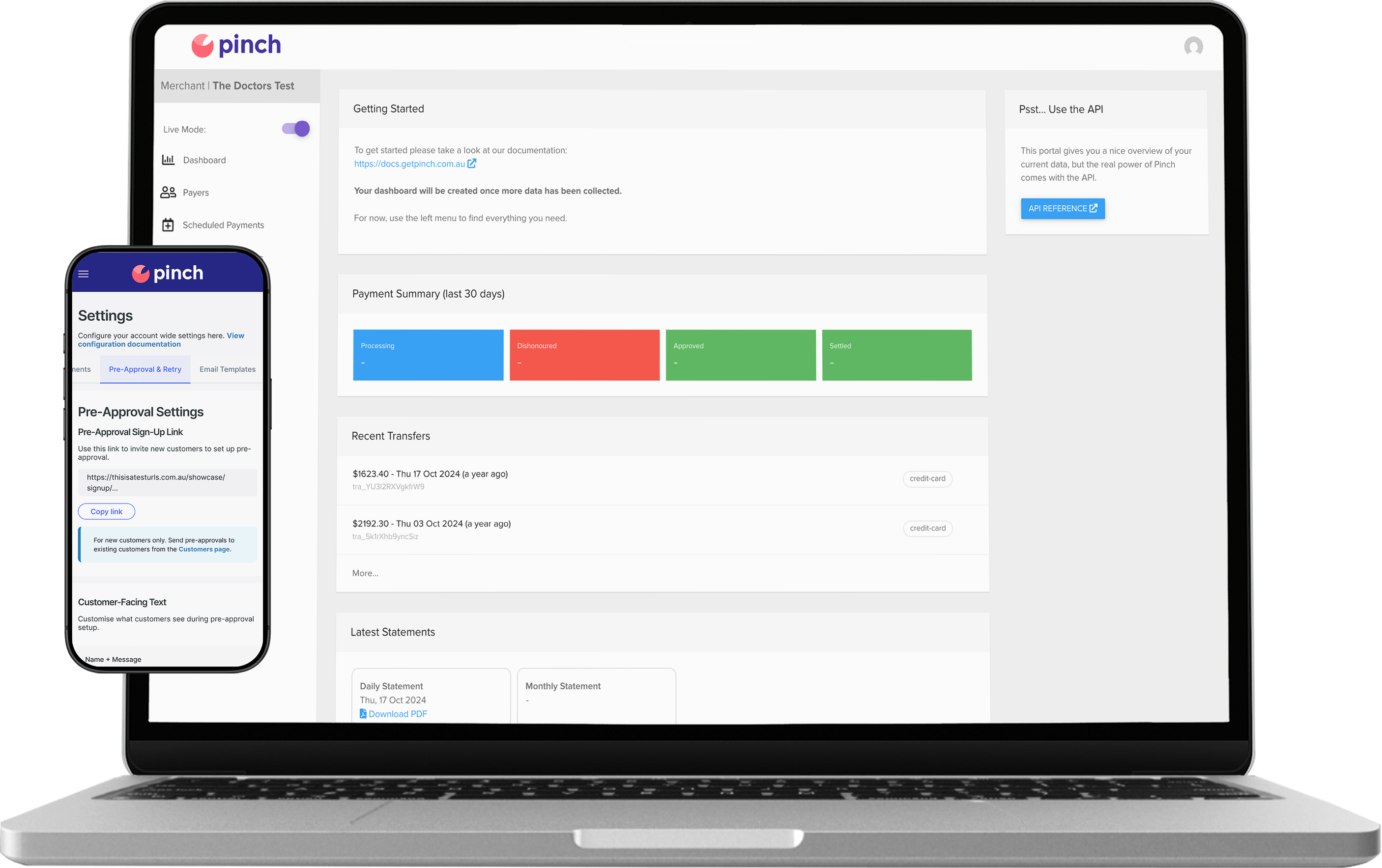
For SaaS companies, Pinch provides an API for integrating payments directly into your own product or workflow. Its Plans and Subscriptions functionality lets developers define reusable payment schedules containing fixed or recurring payments, then attach those plans to individual customers so future payments can be managed automatically. That makes Pinch particularly useful where recurring payments need to fit around your product rather than forcing your product to fit around a rigid billing system.
Pinch supports both card payments and Australian bank account Direct Debit. Its standard Australian pricing is currently 1.70% + 30c for domestic Visa and Mastercard transactions, while Direct Debit costs 1% + 30c, capped at $3 per transaction. There are no monthly fees or transaction minimums, with custom pricing available for businesses processing more than $100,000 per month. Additional fees may apply to certain transactions and services.
Explore the Pinch Payments API
Why SaaS companies might choose Pinch
Pinch is particularly compelling for Australian software businesses that value implementation support alongside the technology itself. Philip Johns, Founder of Australian class-management platform PassM8, describes that partnership: “Pinch helped PassM8 deliver enterprise-grade billing capability from day one, something that would have been impossible without a true integration partner.”
That combination of technology and accessible support also matters when connecting payments with accounting workflows. Digit Business used Pinch’s open API and Xero integration to automate variable billing and build custom client solutions. As Andrew from Digit Business puts it: “What I love most about Pinch is the customer service and accessibility.”
Pinch is a good fit if:
- You’re an Australian SaaS or software business.
- You want to embed card and bank payments into your software.
- Recurring payments are important to your business model.
- You want access to a local team during implementation.
- Your customers already rely heavily on Xero, QuickBooks or MYOB.
- You want payments infrastructure without building everything internally.
Things to consider
If your priority is accepting hundreds of local payment methods across dozens of international markets or running complex multi-currency treasury operations, a globally focused provider such as Airwallex may offer broader international capabilities. Likewise, SaaS businesses that specifically want their payment provider to become the Merchant of Record and assume responsibility for global sales tax may be better suited to a platform such as Paddle.
The difference: Pinch is less about giving an Australian SaaS business another enormous global payments stack and more about providing flexible payments technology backed by people who will actually help you implement it.
2. Airwallex
Best Stripe alternative for SaaS companies with international operations
Airwallex has expanded well beyond payment processing into a broader global financial platform. For SaaS businesses, its offering now includes subscriptions, usage-based billing, invoicing, payment acceptance and multi-currency financial infrastructure.
Airwallex says its Australian platform can accept 160+ payment methods and settle like-for-like in more than 20 currencies. Its subscription management tools support multiple pricing models, different billing frequencies, upgrades, downgrades and payment retries, making it a particularly credible alternative for SaaS companies with customers spread across multiple markets.
Australian domestic card transactions are currently priced from 1.65% + 30c, with subscription management charged at an additional 0.5% per successful transaction.
Airwallex is a good fit if:
- International expansion is a major priority.
- You collect revenue in multiple currencies.
- You also want FX, global accounts or international payouts.
- Your SaaS billing involves usage-based or more complex subscription models.
Things to consider
Airwallex provides a much broader financial operations platform than many SaaS businesses actually require. If your requirements are predominantly Australian payments, recurring billing or embedded payments, that additional scope may not necessarily translate into additional value.
3. Paddle
Best Stripe alternative for SaaS companies wanting a Merchant of Record
Paddle tackles a different problem from a conventional payment processor. Rather than simply processing the transaction, Paddle operates as a Merchant of Record for digital businesses. That means Paddle takes responsibility for areas including payments, billing, sales tax compliance, fraud and chargebacks. For SaaS businesses selling internationally, this can remove a substantial compliance burden.
Paddle’s standard pay-as-you-go price is currently 5% + 50c per checkout transaction, incorporating payments, subscription billing, tax compliance, fraud protection and other services into the fee. Its platform supports subscriptions, usage-based billing, trials and developer integrations through APIs, webhooks and SDKs.
Paddle is a good fit if:
- You sell software or digital products globally.
- International sales tax is becoming difficult to manage.
- You want to outsource Merchant of Record responsibilities.
- You prefer a bundled payments-and-compliance model.
Things to consider
The convenience comes with a materially higher headline transaction fee than conventional payment processing. Paddle is also purpose-built around software and digital goods. If you simply need payment infrastructure rather than a Merchant of Record, you may be paying for a much broader service than you need.
4. Adyen
Best Stripe alternative for enterprise-scale SaaS companies
Adyen is less likely to be the starting point for a small SaaS startup, but it becomes much more interesting once payment volume and international complexity increase. Its platform provides global acquiring, multiple payment methods and unified payments infrastructure through a single integration.
Adyen uses a pricing structure combining a fixed processing fee with payment-method-specific charges, rather than one universal blended transaction rate. That structure can appeal to larger organisations that want greater visibility into their underlying payment costs.
Adyen is a good fit if:
- You operate at enterprise scale.
- You process significant payment volumes.
- You need global acquiring capabilities.
- Your payments team understands interchange and payment-routing economics.
- You want sophisticated payments infrastructure rather than a simple plug-and-play tool.
Things to consider
For smaller SaaS companies, Adyen may introduce more complexity than necessary. Businesses primarily looking for straightforward subscriptions, invoicing or locally supported recurring payments may find a more focused provider easier to implement and manage.
5. GoCardless
Best Stripe alternative for recurring bank payments
Cards are not always the best way to collect recurring SaaS revenue. That is where GoCardless is particularly strong. Its Australian service focuses heavily on one-off and recurring bank payments.
Its Standard plan currently charges 1% + 40c per domestic transaction, capped at $4, with an additional 0.3% applying to payments above $3,000. GoCardless also supports APIs and integrations with more than 350 software platforms and provides automated payment-recovery functionality through its higher plans. For B2B SaaS companies billing larger recurring amounts, the economics of bank-based payments can be particularly attractive compared with percentage-based card processing.
GoCardless is a good fit if:
- Direct Debit is your preferred payment method.
- You primarily collect recurring payments.
- You want to reduce reliance on cards.
- Payment failure recovery is important.
Things to consider
GoCardless is much more specialised around bank payments than platforms such as Stripe, Pinch or Airwallex. If your SaaS product requires a broad mix of cards, wallets and embedded payment capabilities alongside Direct Debit, compare the complete payment workflow rather than transaction pricing alone.
6. Braintree
Best Stripe alternative for businesses using PayPal
Braintree is PayPal’s payment infrastructure platform and remains an option for SaaS businesses that want card processing alongside the PayPal ecosystem.
In Australia, standard Braintree card and third-party digital wallet transactions are currently priced at 1.75% + 30c, while transactions presented outside the merchant's home currency are charged at 3.9% + 30c. Discounted rates are available for businesses processing more than $100,000 per month.
Its developer tooling makes it possible to create customised checkout experiences while supporting PayPal alongside traditional payment methods.
Braintree is a good fit if:
- PayPal is important to your customers.
- You want a custom checkout experience.
- You already operate within the PayPal ecosystem.
- You need a mature API-driven payments provider.
Things to consider
Braintree’s strongest differentiator is its relationship with PayPal. SaaS companies that do not see meaningful demand for PayPal may find that other providers offer a more compelling specialisation elsewhere.
What should SaaS companies look for in a Stripe alternative?
The right processor isn’t simply the company with the longest feature list. SaaS businesses have payment requirements that look very different from traditional ecommerce. A good evaluation should consider the entire recurring revenue workflow.
Recurring payments
Your processor should make it easy to securely save a payment method and collect future payments without asking customers to manually pay every invoice. Look at both cards and bank payments. For larger B2B subscriptions in particular, Direct Debit can provide a useful alternative to card-based billing.
Subscription flexibility
Not every SaaS company bills a flat monthly amount. Think about whether you need fixed subscriptions, payment schedules, usage-based billing, upgrades and downgrades, annual contracts, trials or a mixture of several models. There’s little value paying for sophisticated usage billing if your business only needs a simple monthly recurring charge.
API flexibility
Your payments infrastructure needs to work with the product you’re building. Evaluate the documentation, webhooks, test environment and developer support—not simply whether the provider technically has an API. The question should be: how difficult will this actually be for our team to implement and maintain?
Bank payments
Cards are convenient, but they aren’t your only option. For recurring Australian B2B payments, BECS Direct Debit can be particularly useful. If a substantial proportion of your customers would happily pay from a bank account, compare providers on bank payment functionality as well as card processing.
International requirements
A SaaS business selling primarily in Australia has very different requirements from one billing customers across 30 countries. Multi-currency collection, local payment methods, FX costs, overseas settlement and global tax obligations become significantly more important as you expand internationally. Avoid paying for global complexity before you actually need it—but make sure your provider can support where you're heading.
Implementation and support
Payment infrastructure sits directly between your product and your revenue. When something isn’t working, submitting a ticket into a queue and hoping for the best gets old fairly quickly. Ask what implementation help is available, whether you can speak with people who understand the integration and what happens when something unusual occurs.
Payments technology matters. The people helping you use it matter too.
So, what is the best Stripe alternative for SaaS?
There isn’t one universal replacement for Stripe because these platforms solve different problems.
Pinch is a strong option for Australian SaaS companies that want flexible API-driven payments, cards and Direct Debit, recurring payment capabilities and access to an Australian team that can help with implementation.
Airwallex becomes compelling when international payments, FX and multi-currency operations are central to your growth strategy.
Paddle takes a fundamentally different approach by becoming the Merchant of Record, making it worth considering when international tax and compliance are creating significant operational overhead.
Adyen is suited to sophisticated, high-volume enterprise environments, while GoCardless is particularly strong for recurring bank payments and Braintree makes sense where PayPal is an important part of the checkout experience.
The most important thing is to avoid choosing your payment infrastructure simply because it’s the default. Work backwards from how your SaaS business bills customers, where those customers are located, how much flexibility your developers need and how much help you expect from your payments provider.
Stripe might be the default, but it doesn’t have to be your only option. If you’re looking for flexible payments infrastructure, local expertise and real support from people who understand the Australian payments landscape, Pinch can help.
Disclaimer: The information provided in this guide is for general informational purposes only. It does not constitute legal, financial, or taxation advice. While we strive to provide accurate and up-to-date details based on current Australian regulations, business requirements can change. We recommend consulting with a qualified accountant, lawyer, or business advisor before making any significant decisions or taking action based on this content.
